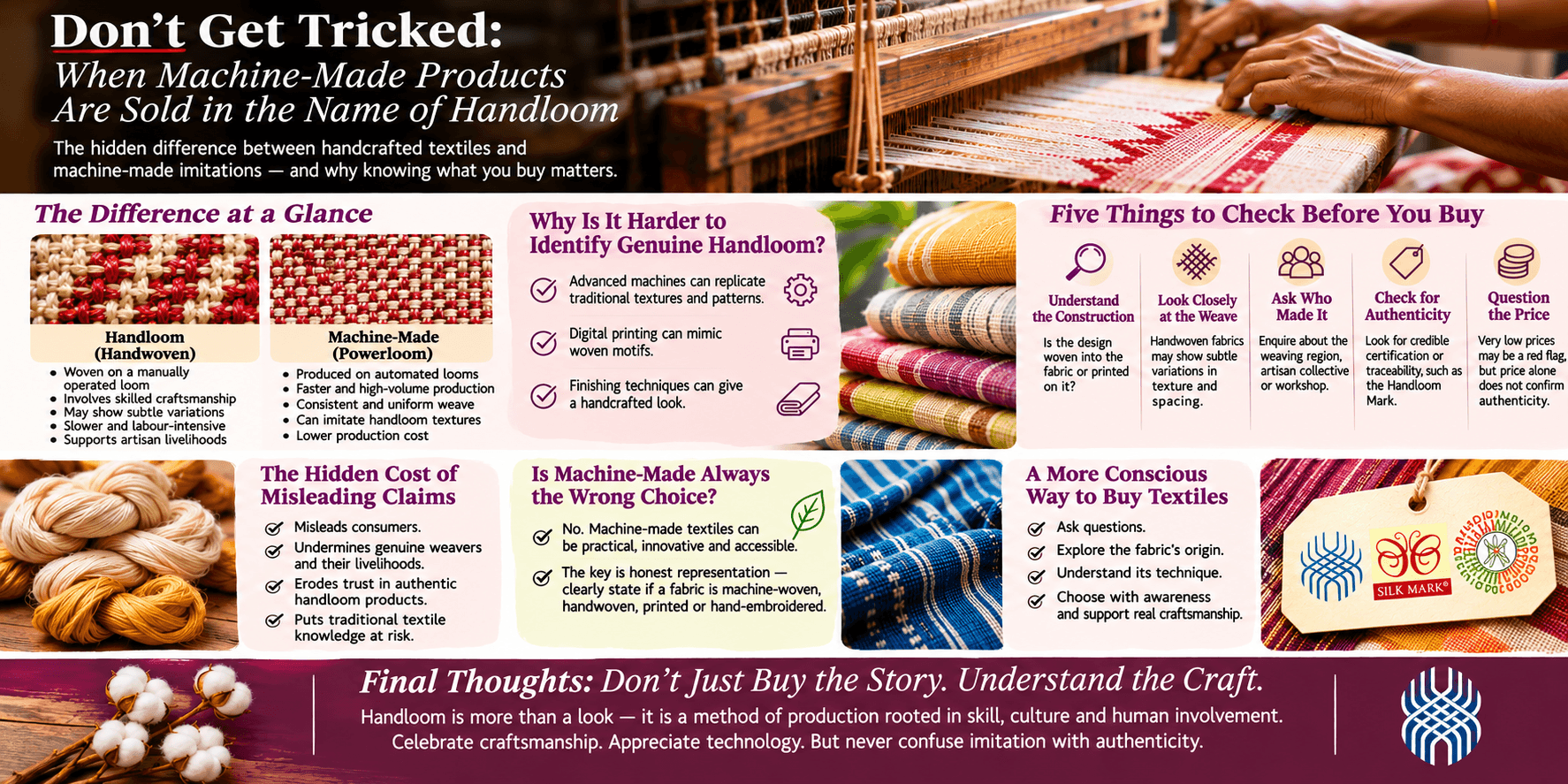
The hidden difference between handcrafted textiles and machine-made imitations — and why knowing what you buy matters.
A fabric can carry the appearance of tradition without carrying the craftsmanship behind it.
Walk through a textile market, browse an online fashion store, or explore a collection advertised as sustainable, and you will frequently encounter words such as handloom, handwoven, artisan-made, and heritage craftsmanship. These descriptions evoke images of skilled weavers, traditional looms, and generations of knowledge passed down through communities.
But how often do we question whether the fabric we are purchasing is genuinely handwoven?
Today, machine-made textiles can imitate the textures, motifs, and irregularities associated with traditional handloom fabrics. While technological advancements have made textiles more accessible and affordable, they have also made it increasingly difficult for consumers to distinguish authentic handloom products from industrially manufactured alternatives.
The concern is not that machine-made fabrics exist. They serve an important purpose in modern fashion. The real problem begins when machine-made products are marketed and priced as authentic handloom textiles.
The Difference Between Handloom and Machine-Made Fabrics
Handloom weaving involves producing fabric on a manually operated loom, where the weaver controls the interlacement of warp and weft yarns through skill and physical effort. Depending on the textile tradition, the process may involve intricate yarn preparation, pattern planning, dyeing, and finishing techniques.
Machine-made fabrics, particularly those produced on power looms, use mechanised systems to achieve faster and more consistent production.
Both methods can produce beautiful, durable, and sophisticated textiles. However, they represent different production processes, labour requirements, and cultural relationships.
A handwoven textile may embody hours or even days of skilled work. Complex designs can take considerably longer. Its value extends beyond the finished fabric to include the knowledge, decisions, and expertise involved in its creation.
When a machine-made textile is sold as handloom, the buyer is not simply receiving a different product. They may also be paying for a story of craftsmanship that does not accurately represent how the fabric was made.
Why Is It Becoming Difficult to Identify Genuine Handloom?
Modern textile manufacturing has become increasingly sophisticated. Power looms and other industrial processes can reproduce patterns and surface effects traditionally associated with handwoven textiles.
Certain machine-made fabrics are deliberately designed to resemble the uneven textures, slub yarns, and handcrafted finishes that consumers associate with artisanal production.
Digital printing can recreate the appearance of traditional woven motifs without those motifs being structurally woven into the fabric.
Similarly, industrial finishing techniques can give textiles a rustic or handcrafted appearance.
This creates a confusing marketplace where visual appearance alone is not always sufficient to establish authenticity.
A fabric may look traditional, feel textured, and feature heritage-inspired motifs while being entirely machine-produced.
Looking handmade is not the same as being handwoven.
Five Things Consumers Should Look for Before Buying Handloom
1. Understand the Fabric's Construction
Examine how the pattern is formed. In a genuinely woven design, motifs may be created through the interlacement of different yarns. Printed designs, by contrast, are applied to the surface of the fabric.
However, not all handloom fabrics contain woven motifs, and not all woven motifs are handmade. Machine looms can also produce complex woven patterns.
The key is to understand the technique rather than rely entirely on appearance.
2. Look Closely at the Weave
Handwoven fabrics sometimes show subtle variations in yarn spacing, tension, and texture because of the manual weaving process.
These variations can reflect the character of the weaving technique.
However, perfectly even handwoven fabrics also exist, particularly when produced by highly skilled weavers. Likewise, machine-made fabrics can be engineered to display irregularities.
Therefore, unevenness should be considered a possible clue, not proof of authenticity.
3. Ask Who Made the Fabric
One of the most valuable questions a consumer can ask is:
“Can you tell me where this fabric was woven and who produced it?”
A transparent seller should be able to provide meaningful information about the textile's origin, production method, or sourcing process.
This might include the weaving region, artisan collective, cooperative, workshop, or manufacturer.
A vague description such as “traditional artisan-inspired fabric” does not establish that a product was actually woven by hand.
4. Check for Authenticity and Traceability
Where applicable, look for credible certification, recognised handloom labels, or reliable documentation of origin.
For example, India's Handloom Mark scheme was introduced to help identify genuine handwoven products.
However, the absence of a particular label does not automatically mean a fabric is machine-made. Many independent weavers and small producers may not participate in certification schemes.
Authenticity is better assessed through a combination of traceability, production information, and credible supporting evidence.
5. Question the Price, but Do Not Judge by Price Alone
Handloom textiles often involve significant skilled labour, making extremely low prices worth questioning, particularly for elaborate designs.
However, price is not a reliable test of authenticity.
Some genuine handwoven products are affordable, while machine-made luxury fabrics can be expensive.
Instead of assuming that a high price guarantees craftsmanship, ask what justifies the price and whether the production claims are transparent.
The Hidden Cost of Misleading Handloom Claims
When industrially manufactured fabrics are presented as handcrafted textiles, the consequences extend beyond consumer disappointment.
Traditional weaving communities depend on the recognition and economic value of their skills. Their livelihoods are connected to specialised knowledge developed and preserved across generations.
When mass-produced alternatives are marketed under the same handcrafted identity, genuine artisans may struggle to communicate why their work deserves different recognition and pricing.
Consumers may also become sceptical of legitimate handloom products, making it harder for authentic producers to build trust.
Perhaps the most concerning consequence is the gradual separation of traditional textile identities from the people and processes that created them.
A motif may survive in mass production while the knowledge required to weave it by hand becomes less economically viable.
Preserving textile heritage therefore requires more than reproducing traditional patterns. It requires recognising and supporting the craftsmanship behind them.
Is Machine-Made Fashion Always the Wrong Choice?
Absolutely not.
Machine manufacturing plays an essential role in the global textile industry. It enables efficient production, consistent quality, technical innovation, and access to fabrics across different price points.
There is nothing inherently dishonest about purchasing or selling machine-made textiles.
A responsibly produced machine-made fabric may also have environmental or practical advantages over certain handcrafted alternatives, depending on its materials, energy use, durability, and overall production conditions.
Likewise, handloom should not automatically be treated as synonymous with sustainability. Fibre sourcing, dyeing, water consumption, labour conditions, transportation, and product longevity all influence environmental and social impact.
The distinction that matters is honest representation.
If a fabric is machine-woven, it should be described as machine-woven. If it is handwoven, that claim should be supported by credible information.
Consumers deserve to understand what they are purchasing.
What Should Fashion Brands and Designers Do Differently?
Fashion brands have a responsibility to communicate textile production methods accurately.
Rather than using handloom as a decorative marketing term, brands should consider providing clear descriptions of how their fabrics are manufactured.
Designers working with traditional textiles can strengthen transparency by documenting weaving processes, identifying artisan partners, and explaining the techniques involved.
Product descriptions should distinguish between genuinely handwoven fabrics, machine-woven textiles inspired by traditional designs, hand-embroidered embellishments, and printed reproductions of woven patterns.
These distinctions may appear small, but they help build a more informed relationship between producers, designers, and consumers.
Transparency also allows traditional craftsmanship and modern textile technology to coexist without one being misrepresented as the other.
A More Conscious Way to Buy Textiles
The next time you encounter a product described as handloom, look beyond its colour, pattern, and marketing story.
Ask questions.
Explore its origin.
Understand its construction.
Consider whether the seller can explain how it was made.
Buying consciously does not necessarily mean purchasing only handmade products. It means making informed decisions based on accurate information.
A machine-made fabric can be a worthwhile purchase when it is honestly represented. A handwoven textile deserves recognition when its craftsmanship is genuine.
The goal is not to create a divide between tradition and technology, but to ensure that each receives the recognition it deserves.
Final Thoughts: Don't Just Buy the Story. Understand the Craft.
In a market where traditional aesthetics can be reproduced at industrial speed, authenticity cannot be judged by appearance alone.
Handloom represents more than a visual style. It is a method of production rooted in technical skill, human involvement, and cultural knowledge.
When machine-made textiles are sold under the identity of handloom, consumers risk being misled, and the distinction that gives traditional weaving its significance becomes blurred.
The future of responsible fashion depends not only on what we create, but also on how truthfully we communicate its origins.
Celebrate craftsmanship. Appreciate technology. But never confuse imitation with authenticity.
Because preserving textile heritage begins with recognising the hands and knowledge behind the weave.